
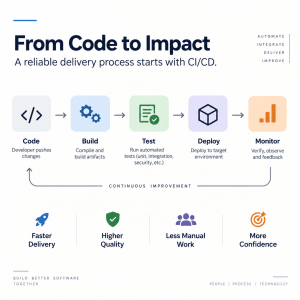
CI/CD is not just a way to automate builds and deployments. It is an important part of building a reliable and maintainable software delivery process.
As applications and teams grow, manual testing and deployment become increasingly difficult to manage. More manual steps mean more room for human error, inconsistent environments, and longer feedback cycles.
A well-designed CI/CD pipeline addresses these problems by introducing automation and standardization into the development lifecycle.
With Continuous Integration, changes are integrated frequently and validated through automated checks such as unit tests, integration tests, static analysis, and security scans. This helps detect issues early, when they are generally easier and less expensive to fix.
Continuous Delivery and Deployment take this further by making the release process repeatable and predictable. Instead of relying on manual procedures, deployments can follow a defined process with proper validation, approvals, monitoring, and rollback mechanisms.
The real benefit is not simply deploying faster.
It is reducing uncertainty.
A mature CI/CD process allows teams to make smaller changes, receive faster feedback, identify failures earlier, and release software with greater confidence.
CI/CD should therefore be considered part of the engineering foundation of a software project, rather than just another DevOps tool or pipeline.

